
Can I File an ENDOTAK RELIANCE Lead Lawsuit?
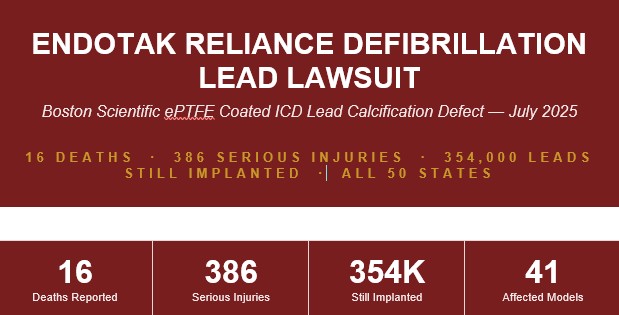
If you or a loved one experienced a failed defibrillation shock, cardiac arrest, emergency lead replacement surgery, or a death during a cardiac event involving a Boston Scientific ENDOTAK RELIANCE ePTFE-coated defibrillation lead, you may have grounds for a product liability lawsuit. The FDA has classified this as its most serious type of recall. As of July 2025, Boston Scientific has confirmed 16 deaths and 386 serious injuries — with an estimated 354,000 leads still implanted in patients across the country. Foster James, LLC is actively reviewing cases nationwide. Consultations are free. No fee unless we recover compensation for you.
What Is the Boston Scientific ENDOTAK RELIANCE Lead Defect?
In July 2025, Boston Scientific issued an “Important Medical Device Information” letter to cardiologists and hospital systems nationwide disclosing a serious defect in its ENDOTAK RELIANCE defibrillation leads coated with expanded polytetrafluoroethylene (ePTFE). The FDA followed with an Early Alert — its formal mechanism for notifying the public about potentially high-risk device issues — and classified the matter as its most serious type of recall, stating: “This device may cause serious injury or death if you continue to use it without correction.”
The core problem: the ePTFE coating on the lead’s shock coils can develop calcium deposits over time. This calcification builds a shell around the coil that acts as an electrical insulator. When a patient’s heart goes into a dangerous rhythm and their ICD fires a shock, the calcified coil may fail to deliver the full intended energy — meaning the shock designed to save their life may not work when it matters most.
Boston Scientific manufactured ePTFE-coated RELIANCE leads from 2002 through 2021 and has estimated that approximately 354,000 remain implanted in patients. The company discontinued ePTFE lead production in 2021, yet these devices remain inside hundreds of thousands of living patients — silently calcifying, in many cases completely undetected.
The full FDA Early Alert is available at: FDA.gov — Update on Alert: Defibrillation Lead Issue from Boston Scientific.
At-a-Glance Facts
| Device Name | ENDOTAK RELIANCE, RELIANCE 4-SITE, RELIANCE 4-FRONT Defibrillation Leads (ePTFE-coated models) |
| Manufacturer | Boston Scientific Corporation — Rhythm Management Division, St. Paul, MN |
| FDA Action | Early Alert — Most Serious Type (“may cause serious injury or death without correction”) |
| Alert Date | Physician Letter: July 24, 2025 · Patient Letter: July 2025 · FDA Update: September 12, 2025 |
| Letter Signatories | Alexandra Naughton, VP Quality Assurance · Kenneth Stein, MD, FACC, FHRS, Chief Medical Officer |
| Affected Models | 41 lead models — ENDOTAK RELIANCE (0160–0187), RELIANCE 4-SITE (0282–0296), RELIANCE 4-FRONT (0657–0696) |
| Manufacturing Period | 2002–2021 (ePTFE leads discontinued; no longer distributed) |
| Estimated Leads In Service | ~354,000 (per Boston Scientific, July 2025) |
| Injuries Reported | 386 serious injuries (as of July 24, 2025) |
| Deaths Reported | 16 patient deaths (as of July 24, 2025) |
| Defect | Calcification of ePTFE-coated shock coil(s) causing gradually rising LVSI and reduced shock efficacy |
| Most Common Harm | Early lead replacement — 1 in 238 ePTFE leads at 10 years (vs. 1 in 10,000 for non-ePTFE leads) |
| Most Serious Harm | Death from failed defibrillation — estimated 1 in 47,500 ePTFE leads at 10 years |
| Onset Timeline | Calcification detectable on average at 8+ years post-implant |
| Shock Polarity Risk | RV+ (Reversed) polarity is 4.5x more likely to trigger Code-1005 than RV- (Initial) polarity |
| Key Impedance Thresholds | >90Ω SC / >70Ω DC: reprogram to RV- and max energy · ≥150Ω: consider lead replacement |
Boston Scientific’s July 2025 Physician Letter: Summary & Key Takeaways
On July 24, 2025, Boston Scientific issued a 13-page “Important Medical Device Information” letter to cardiologists and hospital systems nationwide. The letter was signed by Alexandra Naughton, Vice President of Quality Assurance, and Kenneth Stein, MD, FACC, FHRS, Chief Medical Officer — the two highest-ranking quality and clinical officers at Boston Scientific. This is the most detailed technical disclosure the company has made regarding this defect, and it is the central document in any product liability litigation involving these leads.
What the Letter Disclosed About the Defect
Boston Scientific’s letter disclosed that the company had conducted a comprehensive internal investigation using histological, mechanical, and electrical testing, along with analysis of a de-identified patient dataset from its LATITUDE remote monitoring system covering approximately 250,700 patients. Key findings:
- Calcification originates in the ePTFE membrane itself: The bilaminar coating allows cell debris, proteins, and minerals to enter, initiating dystrophic calcification confirmed by Raman spectroscopy to contain hydroxyapatite — the mineral component of bone
- ePTFE leads calcify far more than non-ePTFE leads: At 10 years post-implant, ~6.4% of ePTFE leads experience gradual rising LVSI, vs. ~0.4% of non-ePTFE BSC leads and ~0.5% of competitor leads — making BSC’s ePTFE design uniquely defective
- RV+ polarity dramatically increases shock failure risk: Reversed (RV+) polarity systems are 4.5 times more likely to trigger a Code-1005 alert compared to Initial (RV-) polarity, with a measurably lower shock success rate
- Commanded shocks do not fix the problem: The letter explicitly states commanded shocks are “neither effective at permanently mitigating rising impedance risk nor predictive of future impedance” — LVSI returns to pre-shock levels in ~50% of cases within six months
- Deaths have occurred during lead extraction: Boston Scientific acknowledged that deaths have been reported as a result of extracting leads with gradually rising LVSI — meaning both leaving the lead and removing it carry mortality risk
“The most serious harm is death or need for cardiac resuscitation due to non-conversion of a sustained ventricular arrhythmia from a reduced shock energy due to high impedance (1 in 47,500 at 10yrs).” — Boston Scientific Important Medical Device Information Letter, July 2025
Impedance Thresholds — The Action Criteria
- >90Ω (SC) / >70Ω (DC): Reprogram shock polarity to Initial (RV-) and all shocks to maximum energy. If patient cannot be reprogrammed, further management guided by LVSI trajectory
- ≥150Ω (either lead type): Lead replacement should be considered. At this level, Initial (RV-) polarity carries a 24.9% likelihood of triggering Code-1005. Shock success rate decreases significantly.
- Code-1005 alert (any impedance): Lead replacement should be considered. Urgency commensurate with likelihood the patient will require shock therapy
A Code-1005 is a high delivered-shock impedance alert that triggers when shock impedance exceeds 145Ω. At Code-1005, BSC defibrillators automatically limit the first shock phase to 20ms, truncating the biphasic waveform to a monophasic shock — directly reducing shock efficacy. This alert in a patient’s episode records is critical evidence in any litigation.
The “Abandoned Lead” Problem
Boston Scientific’s letter recommends that lead replacement may be preferable without extraction — leaving the defective calcified lead permanently inside the patient’s body. This creates a scenario where thousands of patients may carry a known defective device indefinitely. Plaintiffs’ counsel will examine whether this recommendation was driven by genuine safety concerns or by the company’s desire to minimize the scale of documented surgical interventions traceable to its defective product.
What the Letter Directed Physicians to Do
- Continue routine follow-up: In-person or via LATITUDE remote monitoring, with remote monitoring facilitating early detection of rising impedance
- Assess 28-day average LVSI: During every follow-up, determine the most recent 28-day average LVSI unaffected by a delivered shock
- Reprogram polarity and energy: Switch to Initial (RV-) polarity and maximum energy shocks when LVSI exceeds 90Ω (SC) or 70Ω (DC)
- Consider replacement at ≥150Ω: With careful risk-benefit analysis of extraction versus abandonment
- Do not use commanded shocks: The letter explicitly states they are ineffective and non-predictive
- Distribute and document: Share with all HCPs in the organization; include in patient medical records
- Report adverse events: To Boston Scientific at tech.services@bsci.com (1-800-CARDIAC) and to the FDA via MedWatch
Boston Scientific’s Patient Letter: What Patients Were Told
Concurrent with the physician letter, Boston Scientific issued a simplified letter directly to patients, signed by the same two executives — Alexandra Naughton and Dr. Kenneth Stein. The patient letter informed recipients that “some leads are showing signs of a build-up of calcium” that can occur “on average at eight (8) or more years.”
The patient letter reassured patients that the calcium build-up is “highly detectable through routine defibrillation system monitoring,” that programming changes may be available, and that in the “rare case” of abnormal lead function the doctor may want to implant a new lead. It directed patients to BostonScientific.com/lookup to check if their specific lead is included.
The gap between what Boston Scientific told physicians and what it told patients is legally significant. While the physician letter disclosed deaths, impedance statistics, Code-1005 failure rates, and extraction mortality risks, the patient letter described the defect as manageable through routine monitoring and characterized lead replacement as a rare outcome — without disclosing that the most serious harm is death, or that lead replacement itself carries risk of death. This disparity in disclosure may support a failure-to-warn claim.
FDA Early Alert: Summary & Key Takeaways
The FDA issued its Early Alert and updated it as of September 12, 2025, classifying it as its most serious type of recall — “This device may cause serious injury or death if you continue to use it without correction.” Read the official alert: FDA — Update on Alert: Defibrillation Lead Issue from Boston Scientific.
FDA’s Key Findings
- Hazard: ePTFE-coated shock coils can biologically encapsulate and electrically insulate, causing failure to deliver full intended shock energy during cardiac arrest
- Injuries confirmed: 386 serious injuries as of July 24, 2025
- Deaths confirmed: 16 patient deaths as of July 24, 2025
- Shock failure risk at ≥150Ω: Impedance over 150Ω “has been associated with as much as a 1 in 10 risk that life-saving defibrillation shocks will fail”
- Extraction risk: Based on implant time and likely calcification, these leads may pose an increased risk of extraction-related complications
The FDA’s finding that impedance over 150Ω carries as much as a 1 in 10 risk of shock failure is the most striking quantification in the entire alert — and one that does not appear in the simplified patient letter. A 10% probability of failed defibrillation is a serious, foreseeable patient safety risk that Boston Scientific was obligated to disclose clearly and promptly.
What Is the ENDOTAK RELIANCE Lead and Why Did BSC Use ePTFE Coating?
An ICD system has two main components: the pulse generator and the defibrillation lead — an insulated wire running through the veins into the heart to deliver electrical shocks during dangerous arrhythmias. Boston Scientific introduced the ENDOTAK lead system in 1993. In 2002, the company added ePTFE (GORE brand) coating to the shock coils, designing a bilaminar membrane intended to prevent tissue ingrowth and ease future lead extraction.
However, innovations in lead extraction technology after major competitor recalls in 2007 (Medtronic Sprint Fidelis) and 2011 (Abbott Riata) minimized the need for ePTFE coating’s extraction benefit. Boston Scientific discontinued ePTFE lead manufacturing in 2021 — yet never proactively recalled or replaced the 354,000 ePTFE leads already implanted, even as reports of calcification and impedance problems accumulated.
Boston Scientific’s own histological investigation revealed the mechanism: the ePTFE membrane allows cell debris, proteins, and minerals to enter, initiating dystrophic calcification that expands outward, eventually forming a hydroxyapatite shell that encases the shock coil and acts as an electrical insulator. Non-ePTFE leads from BSC and other manufacturers do not exhibit this pattern at remotely comparable rates — making the calcification phenomenon a direct, foreseeable consequence of BSC’s unique design choice.
Who Can File an ENDOTAK RELIANCE Lawsuit?
Patients Who Experienced Failed Defibrillation or Cardiac Arrest
If you have an ENDOTAK RELIANCE ePTFE lead and suffered a cardiac arrest, ventricular arrhythmia not successfully converted by your ICD, or loss of consciousness during a cardiac event, your case warrants immediate legal evaluation. A failed shock attributable to elevated impedance — documented in stored episode data — may directly support a product liability claim.
Patients Who Required Emergency Lead Replacement
If your physician identified elevated LVSI or Code-1005 and you underwent lead replacement surgery, you may have damages including surgical costs, hospitalization, complications, and the risks you were exposed to. The fact that ePTFE leads require early replacement at 42x the rate of comparable leads is itself evidence of a defective design.
Patients Who Suffered Extraction Complications
Boston Scientific acknowledges deaths have occurred during extraction of leads with gradually rising LVSI. If you or a family member suffered vascular injury, heart damage, stroke, or death during ENDOTAK RELIANCE lead extraction, you may have claims against Boston Scientific and potentially the treating physicians.
Families of Patients Who Died
With 16 confirmed deaths as of July 2025 and 354,000 leads still implanted, the death toll will likely grow. Device diagnostic and episode data is the critical first step in determining whether the ICD failed to deliver an effective shock. Foster James can assist in obtaining those records and having them evaluated by a cardiac electrophysiology expert.
Legal Theories in ENDOTAK RELIANCE Lawsuits Against Boston Scientific
1. Defective Design
The ePTFE coating’s bilaminar architecture is inherently prone to dystrophic calcification in the biological environment of a chronically implanted lead. Non-ePTFE alternatives exist and perform at a fraction of the failure rate. Boston Scientific’s own data show ePTFE leads calcify at 42x the rate of non-ePTFE leads — making the design choice indefensible under a risk-utility analysis.
2. Failure to Warn
Boston Scientific knew or should have known about the calcification phenomenon long before July 2025. Published peer-reviewed literature citing this phenomenon predated the alert. With LATITUDE data from 250,000+ patients, the company had unparalleled real-world surveillance. Every patient harmed between when BSC had knowledge and July 2025 may have a claim for delayed warning.
3. Negligent Post-Market Surveillance
Medical device manufacturers have ongoing duties to monitor device performance in the field. Boston Scientific’s failure to identify and disclose the calcification pattern sooner — despite having the world’s largest dataset of ICD remote monitoring data — may constitute negligent post-market surveillance.
4. Breach of Implied Warranty
ENDOTAK RELIANCE leads were sold to hospitals with an implied warranty that they were fit for their intended purpose: delivering effective defibrillation shocks. A lead that calcifies and fails to deliver the intended shock energy is not fit for its purpose.
5. Punitive Damages
Boston Scientific discontinued ePTFE lead manufacturing in 2021 — yet did not issue any formal patient safety communication until July 2025, four years later, during which time 16 patients died. If discovery reveals the company had sufficient internal data to act sooner, courts may award punitive damages.
What Compensation May Be Available?
- Medical expenses: Lead replacement surgery, hospitalization, ICU care, cardiac rehabilitation, and follow-up procedures
- Future medical care: Ongoing monitoring costs, anticipated replacement procedures, and long-term cardiac care
- Lost income: Wages and business income lost during recovery from surgery or due to permanent disability
- Pain and suffering: Physical pain of surgery, trauma of a cardiac event, and ongoing anxiety about device reliability
- Loss of enjoyment of life: Restrictions on physical activity and quality-of-life impairment
- Wrongful death damages: Funeral and burial expenses, lost financial support, loss of companionship and guidance
- Punitive damages: If BSC’s four-year delay between discontinuing ePTFE production and issuing safety communications reflects reckless indifference to patient safety
Key Sources & Official Documents
The following primary sources should be cited as external references on the published web page:
- FDA Early Alert — ENDOTAK RELIANCE Defibrillation Lead Issue (Updated Sept. 12, 2025)
- Boston Scientific Physician Letter — Important Medical Device Information (July 24, 2025)
- Boston Scientific Patient Letter (July 2025)
- FDA — Types of Medical Device Recalls
- MedWatch — FDA Safety & Adverse Event Reporting
- FDA Enforcement Report — Event ID 97318
- FDA Medical Device Recall Database — ENDOTAK RELIANCE
- Boston Scientific Device Lookup Tool
- U.S. Judicial Panel on Multidistrict Litigation
- PACER — Federal Court Electronic Records
| Do You Have an ENDOTAK RELIANCE Lead? We Want to Help. No Fees Unless We Win · Available 24/7 · All 50 States Contact Foster James, LLC for a free, confidential case evaluation. We represent clients nationwide and never charge fees unless we recover compensation for you. foster-james.com | 855-211-8999 |