
| ⚡ Quick Answer: Can I File an Axios Stent Lawsuit? If you or a loved one suffered a serious complication — or a death occurred — during or after a procedure involving an AXIOS Stent or Electrocautery-Enhanced Delivery System, you may have grounds for a product liability lawsuit against Boston Scientific. The FDA has classified this as a Class I recall, its most serious designation, meaning the device “may cause serious injury or death.” Foster James, LLC is actively reviewing Axios stent injury and wrongful death claims nationwide. Consultations are free and there is no fee unless we recover compensation for you. |
What Is the Boston Scientific AXIOS Stent Recall?
In late 2025, Boston Scientific — one of the world’s largest medical device manufacturers — issued an urgent letter to healthcare providers directing them to immediately stop using and distributing certain AXIOS Stent and Electrocautery-Enhanced Delivery Systems. The U.S. Food and Drug Administration (FDA) followed with an early alert in January 2026 and officially classified the recall as Class I on February 25, 2026 — the agency’s most serious designation, reserved for devices that may cause serious injury or death.
The full FDA recall notice is publicly available at: FDA.gov — AXIOS Stent Recall Notice.
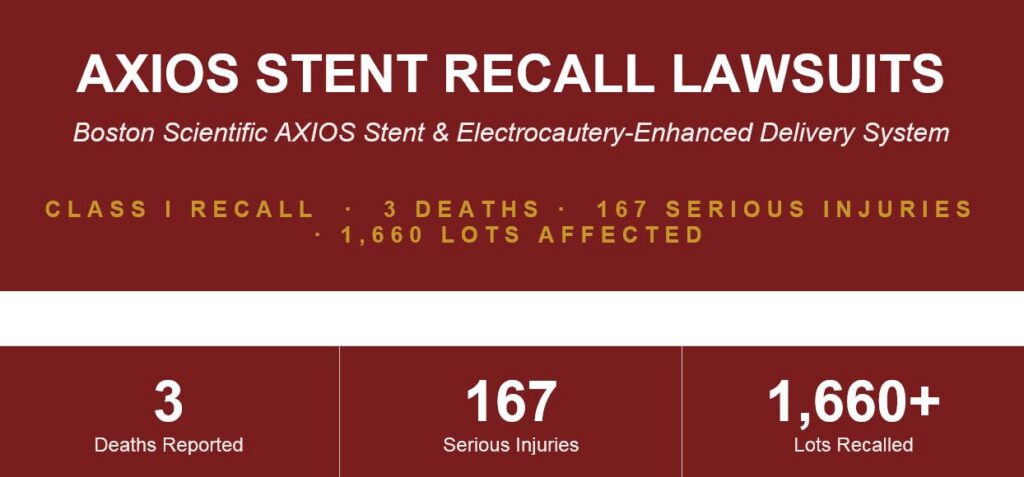
The recall covers 1,660 lots of AXIOS Stents and Electrocautery-Enhanced Delivery Systems used in advanced endoscopic procedures. As of December 23, 2025, Boston Scientific had already reported 167 serious injuries and three deaths associated with a critical malfunction: the stent may fail to deploy or expand properly at the moment of delivery inside the patient’s body. This is also the second major regulatory action against the AXIOS line within a single year. Boston Scientific faced a Class II recall in April 2024 for a similar expansion problem. The pattern of repeated failures raises serious questions about whether Boston Scientific adequately investigated, addressed, and warned physicians about known defects in this device
AXIOS Stent Recall: At-a-Glance Facts
| Device Name | AXIOS Stent and Electrocautery-Enhanced Delivery System |
| Manufacturer | Boston Scientific Corporation (Marlborough, MA) |
| Recall Class | Class I — FDA’s Most Serious Designation |
| Recall Date | February 25, 2026 (Class I); Customer Field Safety Notice: December 19, 2025 |
| FDA Early Alert | Issued January 2026 |
| Field Safety Notice Ref. | 97507023-FA / SRN: US-MF-000004702 / Signed: Conor Dolan, VP Global Quality |
| Specific Sizes Recalled | 6 mm × 8 mm; 8 mm × 8 mm; 20 mm × 10 mm |
| UPN Model Numbers | M00553520 | M00553530 | M00553560 | M00553660 | M00553680 | M00553690 |
| Lots Affected | 1,660 lots across six UPN model numbers (per Attachment 1 of Field Safety Notice) |
| Injuries Reported | 167 serious injuries (as of December 23, 2025) |
| Deaths Reported | 3 deaths (as of December 23, 2025) |
| Problem | Deployment/expansion failures: sheath may not retract to allow deployment; first flange may not fully expand |
| Deaths Linked To | EDGE procedure; gastrojejunostomy; AXIOS GE for GOO IDE study (investigational clinical trial) |
| Prior Recall | Class II recall, April 2024 (nearly identical expansion/deployment issue) |
| Approved Uses | Pancreatic pseudocyst drainage; walled-off necrosis; gallbladder drainage in high-surgical-risk patients |
| Verification Deadline | January 26, 2026 (facilities required to return Verification Form to Boston Scientific) |
Boston Scientific’s December 19, 2025 Letter to Doctors: Summary & Key Takeaways
On December 19, 2025, Boston Scientific issued an Urgent Field Safety Notice titled “Urgent Medical Device Recall” addressed to Materials Managers and Healthcare Providers at every affected facility. The letter — Reference No. 97507023-FA, SRN: US-MF-000004702 — was signed by Conor Dolan, Vice President, Global Quality at Boston Scientific. It is the formal document that triggered the recall and governs what hospitals, surgical centers, and physicians were legally required to do with affected devices.
The letter was addressed to facilities worldwide. It confirmed that Boston Scientific’s own records identified which facilities had received the affected products, meaning the company had tracking data showing exactly where every recalled lot was shipped — a fact that may be significant in litigation establishing corporate notice and traceability.
What the Letter Told Doctors: The Defect
The Field Safety Notice disclosed that Boston Scientific was initiating a removal of three specific size configurations of the AXIOS Stent and Electrocautery-Enhanced Delivery System: 6 mm × 8 mm, 8 mm × 8 mm, and 20 mm × 10 mm (covering six UPN/product numbers detailed in Attachment 1 of the letter). The stated reason was “increased reports of stent deployment and expansion issues” with those configurations.
The letter identified two levels of clinical impact, framed in terms of foreseeability — language that carries legal weight:
“The most common outcome reasonably foreseeable resulting from difficulty deploying the stent is prolongation of the procedure to exchange the device for a new one.” — Boston Scientific Field Safety Notice, December 19, 2025 (Ref. 97507023-FA)
“The most serious reasonably foreseeable outcome in cases where the first flange is unable to deploy or expand would be a cascade of events resulting in additional intervention, either endoscopic or surgical, to remove the stent and close the puncture site.” — Boston Scientific Field Safety Notice, December 19, 2025
Note the word “reasonably foreseeable” — used twice, for each severity level. Under product liability law, a manufacturer’s acknowledgment that an outcome was “reasonably foreseeable” is an admission that the risk was known and anticipated. Boston Scientific’s own letter, in describing these deployment failures as foreseeable outcomes, may provide significant support for a failure-to-warn claim.
What the Letter Said About the Three Deaths
The December 19 letter disclosed three deaths associated with the recalled devices. Boston Scientific characterized them as involving use outside of indication or investigational use: an EDGE procedure, a gastrojejunostomy, and an investigational AXIOS GE for GOO (Gastric Outlet Obstruction) IDE study. The letter stated these events required “a cascade of events with special circumstances such as decision for palliative care, altered anatomy or acute unrelated procedural complication, all of which limited further treatment options.”
This framing — “special circumstances” and “cascade of events” — is a standard corporate litigation defense strategy designed to attribute deaths to patient complexity rather than device failure. It does not necessarily reflect the legal reality. Plaintiffs’ counsel will examine whether the device failure initiated the cascade, whether the “special circumstances” were reasonably foreseeable patient populations for this device, and whether Boston Scientific adequately warned physicians of risks in precisely those scenarios.
Critically, the letter also referenced an active investigational clinical trial — the AXIOS GE for GOO IDE study — one of whose participants died. Deaths in an IDE (Investigational Device Exemption) clinical trial may trigger different regulatory obligations and may support additional theories of liability regarding the scope of informed consent and Boston Scientific’s duties to trial participants.
What the Letter Directed Physicians and Facilities to Do
The Field Safety Notice issued seven numbered instructions to every affected facility:
- Stop use immediately: Discontinue use of all affected units and remove them from inventory, regardless of where within the facility they are stored
- Segregate affected units: Hold all recalled devices in a secure location pending return to Boston Scientific
- Post the notice: Place recall information in a visible location near affected products to ensure all handlers and users can identify recalled units
- Complete the Verification Form: Return the attached Verification Form to Boston Scientific even if the facility had no product to return — creating a paper trail of who received this notice and when
- Prepare and return product: Package recalled devices for return; Boston Scientific would arrange collection after receiving the Verification Form. Deadline: January 26, 2026
- Cascade the notice: Forward the Field Safety Notice to all health professionals within the organization who need to be aware, and to any other organization to which recalled devices may have been transferred
- Restrict use to labeled indications: The letter explicitly reminded healthcare professionals that AXIOS Stents should only be used as indicated in the Instructions For Use — a direct acknowledgment that off-label use was prevalent
- Report adverse events: Any adverse events or quality concerns must be reported to Boston Scientific and to the FDA via MedWatch — FDA Safety Reporting
What the Letter Said About Patients Already Treated
The December 19 letter stated that patients who had already received a successfully implanted AXIOS stent should continue to follow standard of care, because the identified defect occurs only at the time of delivery — not after the device has been placed. This distinction matters in litigation: the window of harm is precisely when patients are under anesthesia, their internal organs punctured, entirely dependent on the device working exactly as designed. A deployment failure at that moment leaves a surgeon managing a surgical emergency in a patient who was not consented for open surgery.
FDA Recall Notice: Summary and Key Takeaways
The FDA’s formal involvement in the AXIOS stent recall unfolded in two stages. First, in January 2026, the agency issued an “Early Alert” — a warning used when the FDA determines a device issue poses a potentially high risk to patients and needs immediate dissemination to healthcare providers. Then, on February 25, 2026, the FDA officially classified the recall as a Class I recall.
Read the official FDA recall notice: Stent Recall: Boston Scientific Removes Certain AXIOS Stents and Electrocautery-Enhanced Delivery Systems.
What Class I Means — and Why It Matters for Your Case
A Class I recall is the FDA’s most serious designation. It means the agency has determined there is a reasonable probability that using the affected device will cause serious adverse health consequences or death. Fewer than 10% of all FDA recalls receive Class I status. The fact that the FDA classified the AXIOS stent recall as Class I is significant legal evidence: it demonstrates that the government’s own regulators concluded this device posed an unacceptable risk of serious harm. Learn more: FDA — Types of Medical Device Recalls.
A Class I recall is the highest-severity designation available to the FDA. It signals that regulators have concluded the device presents a reasonable probability of causing serious injury or death — directly supporting a plaintiff’s product liability claim.
FDA’s Key Findings
- Device name: AXIOS Stent and Electrocautery-Enhanced Delivery System (six specific models)
- Defect identified: Failure of stent deployment and expansion during delivery — the first flange of the stent may not deploy or expand as designed, requiring additional endoscopic or surgical intervention
- Risk: If the first flange cannot be deployed or expanded, surgeons may need to remove the stent and close the puncture site through additional surgery, prolonging the procedure and exposing patients to increased risk of bleeding, infection, perforation, or death
- Injuries confirmed: 167 serious injuries as of December 23, 2025
- Deaths confirmed: 3 deaths as of December 23, 2025
- Scope: 1,660 recalled lots across six AXIOS Stent and Delivery System model numbers
- Prior action: This is the second recall involving AXIOS products within 12 months (Class II recall issued April 2024 for similar expansion failures)
What the FDA Told Healthcare Providers
The FDA’s early alert directed healthcare providers to follow Boston Scientific’s recall instructions — immediately halting distribution and use of affected products. It clarified that patients with already-implanted AXIOS stents should continue standard follow-up care, as the identified defect occurs only at the time of delivery. The FDA stated it would continue to provide updates as the recall process evolved.
The FDA also noted the prior April 2024 Class II recall involving AXIOS products. In product liability litigation, the existence of a prior recall for a nearly identical defect can be powerful evidence that the manufacturer had advance knowledge of a systemic problem — yet failed to correct it before the second wave of injuries and deaths occurred.
What Is the AXIOS Stent? Understanding the Device and Its Uses
The AXIOS Stent — formally the AXIOS Lumen-Apposing Metal Stent (LAMS) — is a medical device developed by Boston Scientific for advanced endoscopic procedures. The device is designed to create a direct internal connection between two adjacent organs or structures, allowing fluid to drain from one cavity into another without open surgery. It is deployed through an endoscope passed through the mouth, making it a minimally invasive alternative to traditional surgical drainage procedures.
FDA-Approved Uses (On-Label)
According to FDA-approved labeling, the AXIOS Electrocautery-Enhanced Stent and Delivery System is indicated to facilitate:
- Transgastric or transduodenal endoscopic drainage of symptomatic pancreatic pseudocysts — fluid-filled sacs that form near the pancreas, often after pancreatitis or pancreatic trauma
- Drainage of walled-off pancreatic necrosis (WOPN) — collections of dead pancreatic tissue surrounded by a wall of tissue, typically a complication of severe pancreatitis
- Gallbladder drainage in patients with acute cholecystitis (gallbladder inflammation) who are at high risk for surgery or considered unsuitable for surgical intervention
These are serious, often life-threatening conditions. Patients receiving AXIOS stents are frequently already medically fragile — dealing with complications of pancreatitis, cancer, or severe infection. That medical vulnerability makes a stent failure especially dangerous: what might be a manageable complication in a healthy patient can become fatal in someone whose body has little reserve.
Off-Label and Investigational Uses Linked to Deaths
Boston Scientific’s device is also used in several procedures not covered by its FDA-approved labeling. These include EDGE (Endoscopic Ultrasound-Directed Transgastric ERCP) — a complex procedure using the AXIOS stent to create a gastric bypass point for accessing the bile ducts in patients who have had bariatric surgery — as well as gastrojejunostomy (creating an internal passage between the stomach and small intestine) and an experimental gastroenterostomy procedure being studied in a clinical trial.
All three of the reported deaths in this recall were associated with these off-label or investigational uses. This does not absolve Boston Scientific of legal responsibility. Courts have consistently held that manufacturers may be liable for foreseeable off-label uses — particularly where the company’s own marketing and sales activities encouraged, or at least tolerated, those expanded applications.
Off-label use is common in medicine and does not automatically prevent a lawsuit. If a manufacturer knew or should have known that physicians were routinely performing procedures beyond the approved labeling, the company has a duty to warn about risks associated with those uses.
How Does the AXIOS Stent Fail? The Mechanics of the Defect
The AXIOS stent’s unique design uses a “lumen-apposing” architecture: the device has two flanges — anchor points — that expand on opposite sides of a tissue wall to hold the stent firmly in place while creating a drainage channel. The stent is delivered through a catheter-based system using electrocautery to puncture the tissue wall, then the delivery sheath retracts to release and expand the stent.
The recalled device fails at this deployment step. Boston Scientific identified two specific mechanical failure modes:
- Sheath retraction failure: The delivery sheath may not retract sufficiently to allow the stent to begin deploying at all. The stent remains trapped inside the delivery system and cannot be released in the intended location.
- First-flange expansion failure: Even when the sheath does retract, the first (distal) flange of the stent may not fully expand. Without a fully expanded anchor flange, the stent cannot be properly seated in the tissue, risking migration, perforation, or loss of the drainage channel.
When either failure mode occurs, the surgeon faces a serious problem mid-procedure. Options include attempting to reposition or redeploy the failed stent, exchanging it for a new device, or — in the worst case — emergency endoscopic or open surgical intervention to remove the stuck stent and repair the puncture site. Every additional minute under anesthesia, and every additional intervention, multiplies risk for a patient who was already ill.
Potential cascading complications from a deployment failure include:
- Internal bleeding from the endoscopic puncture site
- Gastrointestinal perforation if the stent cannot be safely removed
- Peritonitis — infection of the abdominal cavity — if digestive contents leak through the puncture
- Sepsis, a life-threatening systemic infection
- Aspiration pneumonia from prolonged anesthesia
- Organ damage from instrument manipulation during attempted retrieval
- Emergency surgery in patients who are poor surgical candidates
- Death
Who Can File an AXIOS Stent Lawsuit?
You may have the right to pursue a product liability lawsuit against Boston Scientific if you or a family member experienced a complication tied to an AXIOS stent deployment failure. The following categories of potential claimants should contact Foster James, LLC for a free case evaluation:
Patients Who Suffered Serious Injury During an AXIOS Stent Procedure
If you underwent an endoscopic procedure involving an AXIOS stent and experienced a complication — including extended procedure time, emergency surgery, perforation, bleeding, infection, sepsis, or prolonged hospitalization — your injury may be directly traceable to a defective device. This is true regardless of whether you were told the specific stent model used.
To determine whether the device used in your procedure is part of the recall, your operative report, anesthesia record, and hospital billing records will identify the device name and lot number. An attorney at Foster James can assist you in obtaining and reviewing those records.
Families of Patients Who Died
The three deaths reported in connection with this recall remind us that device failures can have irreversible consequences. If a family member died during or following a procedure involving an AXIOS stent, you may have grounds for a wrongful death claim. Wrongful death damages may include funeral and burial expenses, the value of the deceased’s future income and financial support, the loss of companionship and guidance, and the family’s own grief and emotional suffering.
Even where Boston Scientific characterizes the procedure as off-label, that characterization does not end the legal inquiry. If Boston Scientific knew its device was being used in those procedures and failed to issue adequate warnings, liability may still attach.
Patients Across the United States
Foster James, LLC handles mass tort and product liability cases nationwide. Whether you received an AXIOS stent procedure in Georgia, Texas, California, Florida, New York, or any other state, our legal team can evaluate your claim, connect you with local resources, and fight for the compensation you deserve. There are no geographic limitations on who we represent.
Legal Theories in AXIOS Stent Lawsuits Against Boston Scientific
A successful product liability claim against Boston Scientific for AXIOS stent injuries will likely be built on one or more of the following legal theories:
1. Defective Design
A design defect claim alleges that the AXIOS stent’s fundamental engineering is flawed — that even a perfectly manufactured device following Boston Scientific’s own specifications creates an unreasonable risk of deployment failure. If the lumen-apposing architecture, the delivery sheath mechanism, or the electrocautery-enhanced delivery system is inherently prone to failure under foreseeable clinical conditions, Boston Scientific is responsible for every unit shipped with that design. The FDA’s Class I recall — meaning the agency concluded there is a reasonable probability of serious harm — is direct evidence supporting a design defect theory.
2. Manufacturing Defect
A manufacturing defect claim alleges that some recalled devices deviated from Boston Scientific’s intended design specifications during production — perhaps involving materials, assembly tolerances, lubrication, or sterilization that caused the sheath retraction or flange expansion to fail in specific lots. The scope of the recall (1,660 lots) suggests a systemic production issue, not isolated random failures.
3. Failure to Warn
This is often the most powerful theory in medical device cases. Boston Scientific had a legal duty to warn physicians about known risks associated with the AXIOS stent, including the risk of deployment failure. Given that the company faced a virtually identical Class II recall just one year prior, Boston Scientific knew — or certainly should have known — that this failure mode existed. If the company failed to issue timely, adequate warnings, it may be held liable for every injury that occurred between the time it had knowledge of the defect and the time it finally sent its December 19, 2025 letter.
The prior Class II recall in April 2024 for essentially the same expansion problem is a critical piece of evidence. If Boston Scientific identified this defect in 2024 and failed to fully correct it, the company may face significant liability for injuries that occurred after that first recall.
4. Negligence
Beyond strict product liability theories, Boston Scientific may be liable for negligent design, negligent testing, negligent quality control, and negligent post-market surveillance. A medical device manufacturer has an ongoing duty to monitor its device’s performance in the real-world clinical environment and to act promptly when safety signals emerge.
5. Breach of Implied Warranty
When Boston Scientific sold AXIOS stents to hospitals and medical centers, an implied warranty of merchantability attached: the device was warranted to be fit for its ordinary purpose — delivering a stent safely and effectively. A device that fails to deploy is not fit for its purpose, and breach of that warranty may support recovery.
What Compensation Can AXIOS Stent Injury Victims Recover?
Patients and families harmed by the AXIOS stent recall may be entitled to compensation for a wide range of losses. The specific damages available depend on the severity of the injury, whether it resulted in death, and the law of the applicable state — but categories typically include:
- Medical expenses: All costs incurred to treat the stent-related injury, including emergency surgery, ICU care, hospitalization, medications, and rehabilitation
- Future medical care: Anticipated costs of ongoing treatment, follow-up procedures, and long-term care attributable to the device injury
- Lost income and earning capacity: Wages, salary, and business income lost due to inability to work during recovery or on a permanent basis
- Pain and suffering: Compensation for the physical pain and mental anguish of the injury itself, including anxiety, PTSD, and ongoing discomfort
- Loss of enjoyment of life: The impairment of the victim’s ability to participate in activities and relationships they valued before the injury
- Wrongful death damages: Where a patient died, the family’s losses including funeral costs, lost financial support, and the profound loss of companionship and guidance
- Punitive damages: In cases where Boston Scientific’s conduct is found to be particularly reckless — especially given the prior 2024 recall — courts may award additional damages to punish the manufacturer and deter future misconduct
Frequently Asked Questions: AXIOS Stent Recall Lawsuits
What is the AXIOS stent recall and why does it matter?
Boston Scientific recalled 1,660 lots of AXIOS Stents and Electrocautery-Enhanced Delivery Systems in December 2025 after the devices were linked to 167 serious injuries and 3 deaths. The FDA classified the recall as Class I — its highest-severity designation — on February 25, 2026. The recall matters because patients who suffered complications during AXIOS stent procedures may have legal claims for compensation against Boston Scientific.
Can I file a lawsuit if I was injured during an AXIOS stent procedure?
Yes. If you experienced a serious complication — including emergency surgery, perforation, bleeding, sepsis, organ damage, or prolonged hospitalization — during or immediately after an AXIOS stent procedure, you may have a product liability claim against Boston Scientific. The Class I recall is strong evidence that the device was defective. Foster James, LLC will review your case at no charge.
Can my family file a wrongful death lawsuit if a loved one died?
Yes. Families who lost a loved one due to complications from an AXIOS stent deployment failure may bring a wrongful death claim for funeral expenses, lost financial support, loss of companionship, and other damages. Even where Boston Scientific characterizes the procedure as off-label, that does not automatically bar a wrongful death claim. Call Foster James for a free evaluation.
Does off-label use prevent me from filing a lawsuit?
Not necessarily. Off-label use is common in medicine and does not automatically eliminate a manufacturer’s liability. Courts examine whether the manufacturer knew or should have known that physicians were using the device in that way and whether adequate warnings were provided. Boston Scientific may be liable even for deaths and injuries linked to off-label use if the company failed to warn about foreseeable risks.
How do I know if an AXIOS stent was used in my procedure?
Your operative report, anesthesia record, and hospital billing records will identify the specific medical device used and its lot number. An attorney can assist in requesting these records from the hospital. If the device used in your procedure is an AXIOS Stent or Electrocautery-Enhanced Delivery System manufactured by Boston Scientific, it should be compared against the list of recalled lot numbers published by the FDA.
What if the stent was successfully placed — can I still have a claim?
The identified defect occurs at the time of delivery. If your procedure was complicated by a deployment failure — even if the surgeon eventually managed to place a new stent — any injuries caused by that failure may support a claim. Even a shorter-than-normal complication, if it required additional intervention or caused identifiable harm, warrants a legal evaluation.
Is this an MDL (multidistrict litigation)?
As of the time of publication, no federal MDL has been formally established for AXIOS stent recall litigation. However, given the scale of the recall — 1,660 lots, 167 injuries, 3 deaths — and the volume of cases likely to be filed, MDL consolidation is a realistic outcome. Foster James is actively monitoring the litigation landscape and will update clients as developments occur. Attorneys can track federal MDL filings via PACER — Federal Court Electronic Records and the U.S. Judicial Panel on Multidistrict Litigation.
How long do I have to file a lawsuit?
Product liability statutes of limitations vary by state, typically ranging from two to four years from the date of injury or the date the injury was or should have been discovered. Because deadlines can be strict and vary significantly, it is important to contact an attorney as soon as possible. Do not wait to see how the litigation develops — delay can forfeit your right to compensation entirely.
How much does it cost to hire Foster James for an AXIOS stent case?
Nothing upfront. Foster James, LLC handles AXIOS stent recall cases on a contingency fee basis, which means you pay no legal fees unless and until we recover compensation for you. There is no cost to schedule your initial consultation and case evaluation.
Why Choose Foster James, LLC for Your AXIOS Stent Lawsuit?
Foster James, LLC is a personal injury and mass tort firm based in Atlanta, Georgia, with a proven record of fighting large corporations — including medical device manufacturers — on behalf of seriously injured clients and grieving families across the United States. When you are dealing with the aftermath of a catastrophic medical device failure, you need a legal team that knows how to build complex product liability cases and has the resources to see them through.
Nationwide Mass Tort Representation
We handle claims from clients in all 50 states. Whether your procedure took place in Georgia, Texas, New York, Florida, or anywhere in between, our attorneys are equipped to represent you. Mass tort litigation often requires coordinated nationwide case management, and that is precisely what we do.
Proven Record in Product Liability
Our firm has years of experience holding medical device manufacturers accountable for defective products. We understand the complex intersection of FDA regulatory law, product liability theory, and medical causation that drives these cases — and we know how to translate that complexity into compelling advocacy for our clients.
No Fees Unless We Win
You are dealing with enough. Medical bills, recovery, grief, uncertainty — you should not have to worry about paying legal fees while you navigate all of that. Foster James handles AXIOS stent cases on a pure contingency fee basis. If we do not recover compensation for you, you owe us nothing.
Free, Confidential Consultation
Your initial case review with Foster James is completely free and strictly confidential. During that consultation, we will review the facts of your case, explain your legal rights, and give you an honest assessment of your potential claim — with no pressure and no obligation.
Key Sources & Official Documents
- FDA Class I Recall — Boston Scientific AXIOS Stent and Electrocautery-Enhanced Delivery System (February 25, 2026)
- FDA — Types of Medical Device Recalls (Class I, II, III Explained)
- FDA — MedWatch: Safety Information and Adverse Event Reporting Program
- FDA — Investigational Device Exemption (IDE): Overview
- FDA — Medical Device Recalls Database (search AXIOS / Boston Scientific)
- MedTech Dive — Boston Scientific recalls stent over issue linked to 3 deaths (January 20, 2026)
- Beckers Hospital Review — FDA flags safety risk with Boston Scientific stents
- Boston Scientific Corporation — Official Website
- U.S. Judicial Panel on Multidistrict Litigation — Active MDL Proceedings
- PACER — Federal Court Electronic Records System